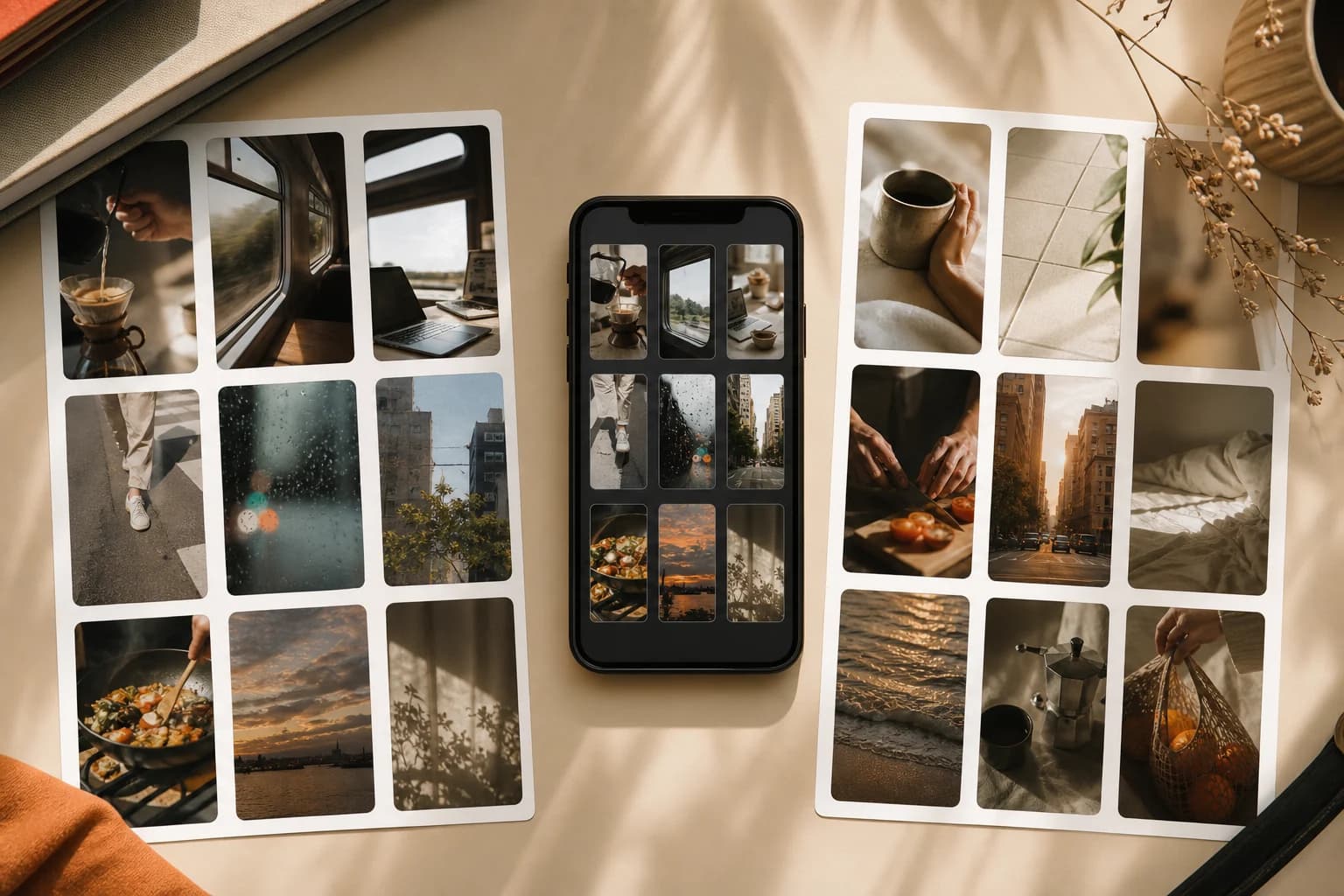
The B-Roll Bank Method: What to Film Before You Know What You're Making
The best time to film your b-roll was three weeks before you knew you needed it. Most creators do the opposite: they finish a script, then scramble to shoot footage for every line — re-pouring the same cup of coffee four times, staging a fake commute, filming their own hands typing at 11 p.m. the night before posting. If you want to end production-day scrambles for good, the fix is learning how to build a b-roll library before any script exists: a running bank of five-second clips from your actual life that future videos can draw from. This is the B-Roll Bank Method — what to film, the 25-clip starter checklist, and a way to keep hundreds of clips organized without naming a single file.
Why Filming On Demand Is the Slowest Way to Make Short-Form Video
Working short-form creators post three to five times a week — that is the cadence platform growth guides consistently recommend, and studies of Shorts channels have found that creators posting five times weekly grow subscribers two to three times faster than weekly posters. Now do the footage math. A 45-second vertical video cut at a typical two-to-four-second pace burns through 12 to 20 clips. Four videos a week means you need somewhere between 50 and 80 usable clips every seven days. If you shoot each one on demand, you are not a creator anymore — you are a one-person production company with a daily call sheet.
A personal b-roll bank flips the sequence. Instead of script, then shoot, then edit, the workflow becomes: capture continuously, script whenever inspiration hits, assemble from what you already have. The individual clips are boring on their own — hands, commutes, coffee, screens, weather. That is the point. Under a voiceover or captions, generic-but-real footage of your life is exactly what the format runs on, and unlike stock, it is recognizably yours.
Do this today: open your camera roll and count the clips from the last 30 days you could reuse under a completely different voiceover. If the answer is fewer than ten, you are filming on demand, and every future video is already behind schedule.
How to Build a B-Roll Library: The Three Rules of the Bank
The B-Roll Bank Method has exactly three rules. Everything else — gear, style, categories — is negotiable.
Rule 1: The Five-Second Rule
Every clip you bank is roughly five seconds long. Not thirty, not two. Five seconds is long enough to survive trimming on both ends (most short-form cuts run two to four seconds), and it clears TikTok's floor — the platform treats videos under three seconds as potentially low-quality, so a five-second source clip always leaves you a safe cut. Just as important: five seconds is short enough that you will actually stop and film it. The moment banking feels like a shoot, the habit dies.
Rule 2: Film Forward — the Narration Test
You film before you have a use, which means you need a decision rule for what b-roll to film. Use the Narration Test: if your future self could plausibly talk over this shot — about productivity, about a rough week, about a client win, about literally anything — it is bankable. If the shot only makes sense with context you would have to explain, skip it. Steam rising off a mug passes the test. A close-up of a specific document does not.
Rule 3: Never Name Anything
No folders, no tags, no descriptive filenames. This sounds like negligence; it is actually the load-bearing rule, and it deserves its own section below. For now: every clip goes into one album called Bank, and that is the entire filing system.
The 25-Clip Starter Checklist
If you are staring at an empty bank wondering what b-roll to film first, seed it with this checklist: five categories, five clips each. These are deliberately unglamorous b-roll ideas for creators — the shots that get reused constantly because they can sit under almost any line of narration.
Hands (the workhorse category)
Pouring coffee or tea, steam visible
Typing on your keyboard, shot from the side at desk level
Writing in a notebook, pen strokes legible
Opening a laptop lid from closed to ready
Scrolling your phone, screen angled slightly away to kill glare
Motion and commute
Your feet walking, camera pointed down
Out the window of a bus, train, or car (as a passenger)
Locking or unlocking your front door
Crossing a street when the light changes
An escalator ride or elevator doors closing
Screens and work
Over-the-shoulder laptop shot with a neutral document or dashboard up
A graph, feed, or timeline scrolling on screen
Closing the laptop at the end of the day
A notification landing on your lock screen (stage it)
A desk reset — sweeping mess into order in one motion
Consumables and rituals
The counter handoff at your usual coffee shop
Any breakfast motion: a pour, a sizzle, a stir
Refilling a water bottle
Opening a package or peeling a label
A microwave or kettle countdown
Environment and weather
Rain hitting your actual window
Sunrise or sunset from wherever you really live — not a scenic overlook
Wind moving trees or a curtain
One static wide shot of your street (re-film it each season)
Clouds moving — take ten seconds here, the one exception to Rule 1
Twenty-five clips at five seconds each is barely two minutes of total footage. You can bank the entire starter checklist in one ordinary day without changing your schedule — the clips are already happening around you; the only new behavior is pointing a phone at them.
Filming Clips That Match Any Future Script
Add one moving element
Static shots read as photos. Every banked clip should contain exactly one motion: the pour, the scroll, the walk, the steam. If the subject cannot move, you move — a slow half-step push toward the mug beats a locked-off frame. One motion, not three; busy clips are harder to match to narration later.
Shoot vertical, hold steady, count to six
Shoot 9:16 at 1080 x 1920 — the current spec across TikTok, Reels, and Shorts — so nothing needs cropping later. Brace your elbows against your ribs, start recording, then silently count to six before you stop. That buffer is what makes the Five-Second Rule survive trimming. If your hands shake, lean the phone against whatever is nearby; a coffee cup is a tripod.
Vary distance, not location
You do not need new places; you need new framings of the same place. When something passes the Narration Test, grab it twice: once close (hands, texture, detail) and once medium (you or the scene in context). Two distances of one moment doubles your bank and gives future edits a natural cut pair.
The Contrarian Part: Never Organize Your Bank
Almost every guide on how to build a b-roll library tells you to build folder trees, write descriptive filenames, and tag clips after every shoot. That advice is precisely why most b-roll banks die within a month — tagging is a second job, and the bank only works if capture costs nothing. The honest truth is that manual organization solved a problem that no longer exists: finding clips by memory. AI matching removed it.
The naming-free workflow looks like this: every clip goes into one album, untouched. When you have a script, you hand the pile of clips and the script to a tool that matches them. This is the workflow ClipMatch is built around — you upload the clips you already have, write what happened line by line (or paste a script), and it matches each line to the best clip and assembles the vertical video for Reels, TikTok, or Shorts. No timeline, no tags, no filenames. The bank stays a dumb pile, and the pile is the feature.
One caveat, honestly: if your edit needs keyframes, speed ramps, or a transitions library, an assemble-fast tool is not the right instrument — that is still CapCut or a desktop editor territory. The bank method pairs best with talk-over-footage videos, which is most of what working creators post anyway. And keep one manual habit: a ten-minute monthly cull of blurry or accidental clips. Deleting is the only organizing you ever do.
The Math: What Two Clips a Day Buys You
Here is an illustrative week, with the numbers spelled out so you can check them against your own workflow.
Bank two clips a day. At five seconds each plus framing time, that is about one minute of daily effort — roughly seven minutes a week.
After 30 days you have around 60 clips. A 45-second vertical video at two-to-four-second cuts needs 12 to 20 clips, so one month of banking covers three to five complete videos with zero dedicated shoot days.
When a script idea lands, writing 12 to 15 lines takes about ten minutes. Assembly against your bank is minutes, not an evening. On ClipMatch, a finished video costs $2.99 (your first three are free), so the marginal cost of a posted Reel drops to roughly 15 minutes of your time and three dollars.
Compare that to the on-demand version of the same video: 40 to 60 minutes of shooting to order, plus an editing session. At four posts a week, banking claws back three to four hours every single week.
After a year of the two-a-day habit you are sitting on roughly 700 clips — a personal stock library no competitor can license, filmed at a cost of about six hours total.
FAQ
How many b-roll clips do I need before I can make my first video?
About 12 to 20 for a single 45-second video, which is why the 25-clip starter checklist is sized the way it is: finish it and you can assemble your first video the same day. Do not wait for a big bank — the bank grows fastest once you are actively drawing from it, because usage teaches you what to film more of.
How long should b-roll clips be?
Film five to six seconds; use two to four. Short-form edits cut fast, and TikTok flags videos under three seconds as potential low-quality content, so a five-second source clip always trims down safely. The exceptions are ambient shots — weather, clouds, traffic — where ten seconds gives you room for a slow moment in the edit.
Should I use stock footage instead of filming my own b-roll?
Stock fills gaps, but it reads as stock — the lighting is too clean and the hands are never yours. A personal b-roll bank compounds differently: viewers start recognizing your desk, your street, your mug, and that familiarity is a retention asset no subscription library sells. Use free stock (Pexels and similar) for shots you genuinely cannot capture, and film everything else.
How do I stockpile video clips without filling up my phone?
A five-second 1080p clip runs roughly 15 to 25 MB, so even a full year of two-a-day banking is on the order of 15 GB. Offload the Bank album to cloud storage or a drive monthly, keep the last 60 days on-device for fast assembly, and do the ten-minute cull before each offload. You can stockpile video clips for years this way without ever thinking about storage again.
The B-Roll Bank Method is not a production technique; it is a habit with a five-second unit cost. Film two clips today — one from the Hands category, one from Motion — and put them in an album called Bank. In a month you will write a script, realize the footage already exists, and wonder why you ever did it the other way around. That is the whole method: learn how to build a b-roll library by never scheduling a shoot again.